
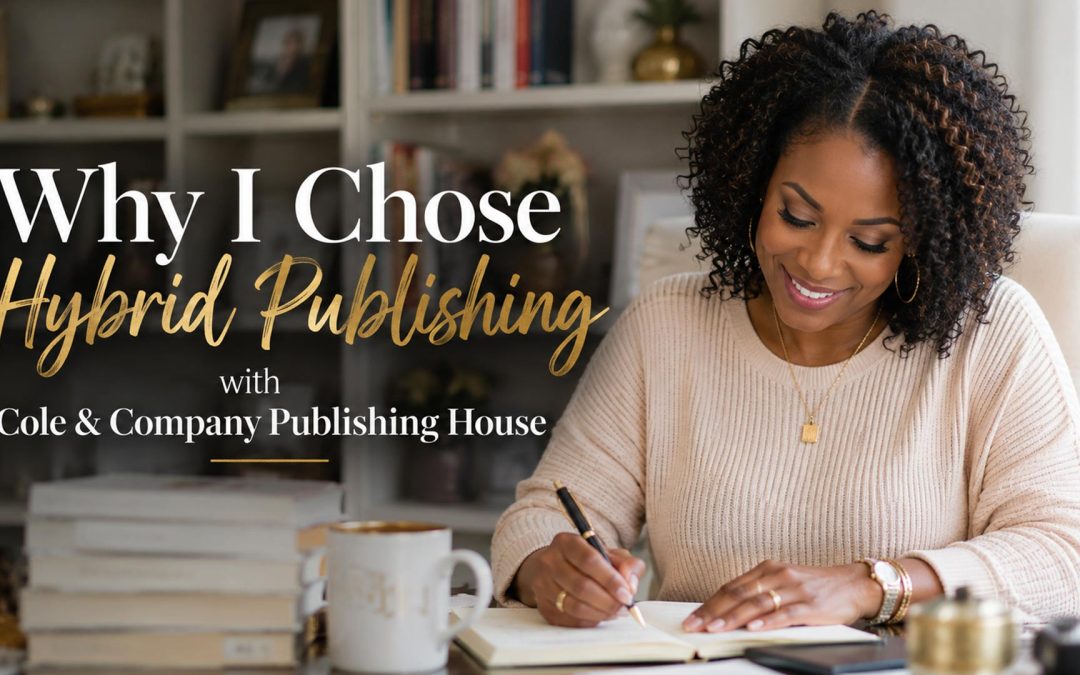
“I wanted my cake and I wanted to eat it too. I wanted every benefit a traditional publisher could offer, and I refused to surrender a single right, a single dollar, or a single dimension of my creative vision to get it. So I built the publishing house I could not find.”
When I set out to publish my own work, I did what every serious author does: I researched every option. I understood the prestige of traditional publishing. I understood the freedom of self-publishing. And I understood, very clearly, that neither of them gave me everything I needed without asking me to sacrifice something I was not willing to give up. I did not think I should have to choose between owning my rights and receiving the full support of a professional publishing team. So I studied both worlds from the inside, identified exactly where each one failed authors, and built something better. Here is an honest breakdown of all three paths and why the hybrid/independent model is the one I designed my company around.
The Three Publishing Paths, Explained
Every author faces the same fork in the road. Understanding each path before you choose is one of the most important decisions you will make as a writer.
Path 1
Traditional Publishing
- Publisher funds production
- Author earns 10–15% royalties on print[1]
- Agent takes 15% commission[2]
- Publisher controls title, cover, pricing
- 1–3 year timeline to publication
- Rights partially or fully signed away
- Most manuscripts are rejected
Path 2
Self-Publishing
- Author funds and manages everything
- 70% eBook royalties on KDP (eligible prices)[3]
- Full creative control
- Author retains all rights
- Can publish in days or weeks
- No marketing or distribution support
- Author must source and manage every professional
Path 3
Hybrid / Independent Publishing
- Author invests in professional services
- Author keeps 100% of rights
- Author keeps 100% of proceeds
- Professional editing, design, and distribution
- Marketing support as an add-on option
- Publishing partner guides the journey
- Faster timeline than traditional publishing
Hybrid publishing emerged to close the gap between the gatekeeping of traditional houses and the go-it-alone difficulty of self-publishing. Wikipedia describes hybrid publishing as a model that occupies the middle ground between the two, offering professional production with greater author control and higher royalty potential.[4] The best version of this model, the one Cole & Company Publishing House practices, takes it further: no royalty split, no rights claim, just professional partnership.
How Do the Three Models Actually Compare?
Numbers tell the clearest story. Here is a side-by-side look at what each publishing path typically offers on the factors that matter most to authors.
| Factor | Traditional | Self-Publishing | Cole & Company Hybrid |
|---|---|---|---|
| Royalties | 10–15% print / 25% ebook | 35–70% (platform-dependent) | 100% of proceeds to author |
| Rights ownership | Publisher acquires rights | Author retains all rights | Author retains 100% of rights |
| Editorial support | Full (dev, copy, proofread) | Author sources independently | Full editorial pipeline included |
| Cover design | Publisher decides | Author sources independently | Professional design included |
| Marketing support | Publisher team (limited for new authors) | Author handles all | Available as add-on option |
| Creative control | Publisher has final say | Full author control | Full author control |
| Timeline | 1–3 years | Weeks to months | Efficient, guided timeline |
| Writing guidance | Sometimes, from an editor | None unless self-sourced | Journey support from day one |
Why I Chose Hybrid Publishing
I had experienced traditional publishing from the inside, and I understood exactly what it cost authors. Standard Big Five hardcover royalties run 10% on the first 5,000 copies, rising to 15% after 10,000, with 15% of everything going to a literary agent before the author sees a penny.[1][2] Beyond the royalties, authors sign away rights, accept cover decisions they did not make, and wait years for a book they wrote to reach readers. I had watched this happen to writers with genuine talent and important stories to tell. I was not willing to accept those terms for myself, and I was not willing to offer them to anyone else.
Self-publishing solved the rights and royalty problem but created a different one. The author becomes the publisher, the project manager, the quality control department, and the marketing team all at once. Sourcing and coordinating every professional, from developmental editors to cover designers to distribution platforms, falls entirely on the writer. For many authors, that becomes a second full-time job that pulls focus away from the work itself. I had seen that too, and I knew there had to be a better answer.
So I hand-crafted one. Cole & Company Publishing House was built specifically for the author who refuses to choose between creative ownership and professional excellence. I wanted my cake and I intended to eat it too: 100% of my rights, 100% of my proceeds, and every resource a traditional publishing house would offer, on my terms. According to a 2025 guide on hybrid publishing models, royalties of 50% to 80% are not unusual in the hybrid space, and reputable hybrid publishers allow authors to retain full copyright ownership.[6] I designed Cole & Company to go further than that entirely, because I did not think authors should settle for anything less than everything they had earned.
What Cole & Company Publishing House Provides
Professional publishing is not a single service. It is a sequence of expert contributions, each one building on the last. Cole & Company Publishing House covers every stage, so no part of your book’s journey is left to chance.
Developmental Editing
Developmental editing is the first and most transformative stage of the editorial process. It focuses on the big picture: structure, argument, narrative arc, pacing, character development, and the overall logic of your book.[7] It must always come before copy editing or proofreading, because no amount of sentence-level polish can repair a manuscript with structural gaps or an underdeveloped argument. Skipping this stage risks publishing a book with plot holes, pacing problems, or logical inconsistencies that no later editing pass can fix. Our experienced developmental editors work with you to ensure the foundation of your book is solid before anything else moves forward.
Copy Editing
Once the structure is strong, copy editing refines the manuscript at the sentence level. A copy editor corrects grammar, punctuation, spelling, and consistency, and ensures the manuscript adheres to the appropriate style guide.[8] This is where your writing becomes polished, consistent, and professional. Skipping copy editing is one of the most common reasons self-published books underperform and draw critical reader reviews.[9]
Proofreading
Proofreading is the final quality check before publication. It is not interchangeable with editing: it assumes the manuscript has already been edited and focuses narrowly on catching typographical errors, formatting inconsistencies, and anything that slipped through during copy editing or was introduced during layout.[7] A single typo can cause a reader to question the professionalism of a book; multiple typos can damage an author’s reputation. Our proofreaders provide the critical human safety net that catches what automated tools miss.
Book Cover Editing
A professional book cover is not decoration: it is a marketing tool and a credibility signal. Readers make purchase decisions in seconds, and your cover is often the first thing they see. Cole & Company Publishing House provides professional cover design that reflects your genre, your audience, and your vision, without the publisher overriding your preferences. You approve the final design, because it is your book.
Marketing Support (Add-On)
Marketing is where many independently published books stall. Cole & Company offers marketing support as a flexible add-on option, recognizing that not every author has the same needs or the same budget. Options include launch strategy, author platform development, reader outreach, and promotional planning. You choose the level of support that fits your goals, and we deliver it without claiming a percentage of your sales in return.
Writing Journey Assistance
Not every author arrives with a completed manuscript. Some have a chapter and a vision. Others have an idea and need help finding their voice. Cole & Company Publishing House supports authors at every stage of the writing journey: from early-stage development and structural guidance to manuscript coaching and accountability. We believe the writing process is part of the publishing process, and our authors should never feel alone in it.
What Makes Cole & Company Different from Other Hybrid Publishers
Not all hybrid publishers operate the same way. Wikipedia’s entry on hybrid publishing distinguishes true hybrid publishers from vanity presses by a critical test: a legitimate hybrid publisher evaluates manuscripts for quality and merit, just as a traditional publisher does, and shares the financial investment and risk with the author.[4] Vanity presses, by contrast, publish anything for anyone, provide little real editorial oversight, and often deliver far less than they promise.
Cole & Company Publishing House goes beyond the standard hybrid model in two meaningful ways. First, the author keeps every dollar earned from book sales. Most hybrid publishers still take a royalty share, typically between 10% and 50% of net proceeds.[10] At Cole & Company, that share is zero. Second, the author retains full ownership of their intellectual property, including print, eBook, audio, foreign rights, and any future adaptation rights. No buyback clauses, no rights retention periods, no fine print.
Jane Friedman, one of the most respected voices in publishing, describes the best publishing service models as those in which the author retains 100% of rights and net sales earnings, with the company earning through transparent service fees rather than royalty splits.[11] That is exactly how Cole & Company Publishing House operates.
The People in Your Corner
The most important thing I can offer you as a publishing partner is not a service menu or a price list. It is people who know what excellent looks like because they have spent careers building it.
When I built this team, I had one standard that was never negotiable: everyone had to have done the work, not just studied it. The editors, designers, film professionals, developers, and marketing experts who work with our authors are not generalists filling seats. They are specialists I recruited because of what they had already accomplished, the publishing houses they had worked inside, the books they had helped bring to life, the campaigns they had run, and the authors they had guided. I did not want to build a company that talked about publishing. I wanted to build one staffed by people who had lived it.
Who You Are Actually Working With
Most hybrid publishers subcontract to whoever is available. Every professional who works with our authors is someone I trust with my own name on the cover, because in a very real sense, every book we publish carries the reputation of this company alongside the author’s.
Editors
The editors I work with have spent years inside the manuscript process, across a wide range of genres and formats. They bring the full editorial range: developmental, copy, and proofread, and they adapt their approach to fit your book, your voice, and your audience, not a one-size house style.
Graphic Designers
The designers on our team hold professional credentials in visual communication, typography, and print production. They understand what makes a cover work in a specific genre and have designed for both traditional and independent channels. Your vision guides every decision, and you approve the final result.
Video and Film Professionals
I brought in video and film professionals with real production credits because I believe the way a book is brought to life visually matters as much as how it reads on the page. From author trailers to social content to brand storytelling, this team knows how to translate a book’s voice into moving image.
Web Developers
Every author needs a professional digital home, and the developers I work with build author websites that are fast, mobile-ready, and built for discoverability. They combine technical expertise with a genuine understanding of what readers, booksellers, and literary communities look for when they find you online.
Marketing and Sales Experts
The marketing professionals on our team bring deep experience across independent author platforms, wholesale and retail channels, libraries, and media outreach. They know both the institutional channels and the direct-to-reader strategies that drive real, sustainable book sales, and they bring that expertise to every launch we support.
Writing Journey Support
Some of the most valuable support I can offer comes before a manuscript is finished. The writing journey coaches I work with have navigated the process themselves. They know what it feels like to face a blank page, to lose the thread of a chapter, and to find it again. You are not alone in this, at any stage.
Experience and Training That Shows in the Work
What I look for when I build and grow this team is not a resume that looks impressive on paper. It is evidence of real work done at a real level, in the field, over time. The credentials our team holds reflect that standard.
What holds this team together is not a shared employer. It is a shared standard. Every person I bring into Cole & Company Publishing House is here because they believe that authors deserve the same quality of professional attention that major publishers reserve for their most commercially valuable titles, regardless of whether this is your first book or your fifth. That belief is not a marketing line. It is why I built this company, and it is the standard every member of this team works to every single day.
Frequently Asked Questions
What is the difference between hybrid publishing and vanity publishing?
A vanity press will publish any book for any author for a fee, with little or no editorial standards and limited real distribution. A legitimate hybrid publisher evaluates manuscripts, provides genuine professional services, and has a vested interest in the success of the books it takes on. The essential test is whether the publisher exercises editorial selectivity and shares the financial risk rather than simply collecting fees for minimal work.[4]
Does Cole & Company Publishing House take any percentage of my book sales?
No. Cole & Company Publishing House earns through service fees, not royalty splits. Every dollar your book generates goes to you. This is the defining difference between our model and most traditional hybrid publishers, who typically retain 10–50% of an author’s proceeds.
Do I keep my rights when publishing with Cole & Company?
Yes, completely. You retain 100% of your intellectual property, including print, eBook, audio, translation, and adaptation rights. There are no exclusivity periods and no buyback clauses. Your book belongs to you.
Why does professional editing matter so much for a book’s success?
Professional editing is one of the clearest indicators of book quality, and readers notice when it is absent. The self-publishing market released 2.6 million titles with ISBNs in the US in 2023 alone; books that stand out are increasingly those that have received professional editorial attention at every stage.[7] Skipping editing to save money is one of the most common reasons self-published books underperform.[9]
What if my book is not finished yet? Can Cole & Company still help?
Yes. Cole & Company Publishing House supports authors at every stage of the writing journey, including early-stage manuscript development, structural guidance, and writing coaching. You do not need a completed manuscript to begin the conversation.
What qualifications does the Cole & Company team have?
The Cole & Company Publishing House team is made up of specialists with formal degrees, professional training, and years of hands-on experience in their respective fields, including English and creative writing, graphic design, film and media production, web development, and marketing and sales. Critically, our team has worked inside both traditional publishing houses and the self-publishing ecosystem, giving us a complete picture of what works, what does not, and how to deliver the best possible outcome for every author we serve.
Is hybrid publishing faster than traditional publishing?
Significantly. Traditional publishing typically takes 1–3 years from finished manuscript to bookstore shelf, including the querying process alone. Hybrid and independent publishing timelines are driven by the author’s goals and the editorial pipeline, not by publishing house acquisition schedules or seasonal catalog decisions.
The Bottom Line
The publishing industry was built on a model that made sense when printing presses were scarce and distribution required massive infrastructure. That world no longer exists. Today, an author who writes a great book, invests in professional editing and design, and publishes with the right partner can reach readers everywhere without surrendering their rights, their income, or their creative vision.
I did not stumble into hybrid publishing. I designed it, deliberately and carefully, because I had lived the problem from both sides. I knew what it felt like to be an author watching the traditional model ask for more than it gave back. I knew what it felt like to carry the entire weight of self-publishing alone. And I knew, with complete certainty, that no one should have to choose between owning their work and publishing it well.
Cole & Company Publishing House is the answer I sculpted for myself and then opened to every author who has ever felt the same way. The professional team, the full editorial pipeline, the cover design, the marketing support, and the guidance through every stage of the writing journey are all here. And every right you hold, and every dollar your book earns, belongs entirely to you.
That is not a compromise between two imperfect options. That is what publishing should have looked like all along.
Ready to start your publishing journey?
Cole & Company Publishing House works with authors at every stage, from first draft to final launch. Your story, your rights, your proceeds.
Sources
1. The Authors Guild. “Model Trade Book Contract, Section 5: Royalties.” authorsguild.org
2. Jericho Writers. “Literary Agent Fees: What You Need to Know.” jerichowriters.com
3. Reedsy. “Amazon Self-Publishing Royalties: How Much Can Authors Earn on KDP?” Updated June 2025. reedsy.com
4. Wikipedia. “Hybrid Publishing.” Updated February 2026. en.wikipedia.org
5. Hillshire Media. “Hybrid Publishing: The Author’s 2026 Guide to Smart Choices.” May 2026. hillshiremedia.co
6. Proof Reading Service. “Understanding Hybrid Publishing: A Guide for Academic and General Authors.” July 2025. proof-reading-service.com
7. ebookpbook by Newgen. “Developmental Editing vs Copy Editing vs Proofreading.” April 2026. ebookpbook.com
8. All in the Edit. “The Ultimate Guide to Developmental Editing, Copy Editing, and Proofreading.” allintheedit.com
9. Editor World. “Developmental Editing vs. Copy Editing vs. Proofreading.” editorworld.com
10. Reedsy. “What Is Hybrid Publishing? Expectations vs Reality.” March 2026. blog.reedsy.com
11. Friedman, Jane. “The Key Book Publishing Paths: 2025–2026.” February 2025. janefriedman.com